Hotline: +381 61 63 84 071



Sometimes the most important thing is simply to be there
Sometimes the most important thing is simply to be there
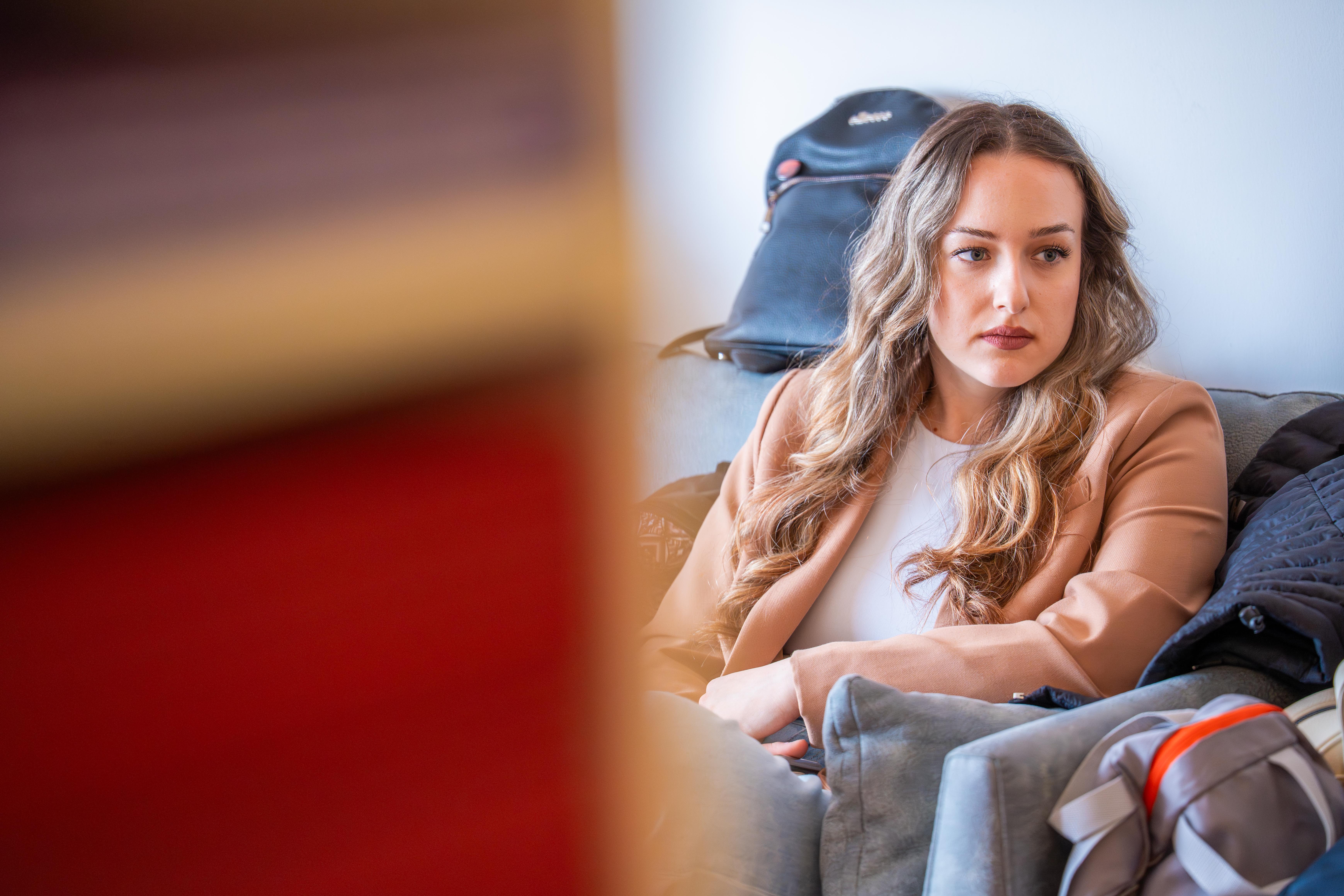
Interview with Sara Pavlović, social worker at NGO Atina
Photo: Dragan Mujan
Sara Pavlović is a social worker and a case manager at NGO Atina, where she provides direct support to girls and women who have survived human trafficking and various forms of violence. Her work begins with the very first contact, through building trust and offering day-to-day support to women who are trying to rebuild their lives. In addition, Sara facilitates workshops for migrant women at the Reception Center for Refugees in Obrenovac, where conversations and support foster a safe space where women can feel seen, heard, and empowered.
In this interview, she speaks about trust, the small steps that make a significant difference, and what it truly means to stand beside someone who is trying to rebuild their life. She also reflects on how this work is learned through presence, patience, and everyday engagement with people.
Support is learned through people, not only through books
“I cannot point to a single turning point when I decided that this was exactly the work I wanted to do. During my third year of university, I had the opportunity, through a field placement, to see how the system functions, but also how important support is when it goes beyond formal procedures. That experience ultimately brought me to NGO Atina, where I found a work environment grounded in trust, respect, and long-term support.
The team's support was essential to me. I learned through observation, conversations, and daily practice. It was important for me to learn how to approach this work in a respectful, non-intrusive, and safe way. The Atina collective brings together people with diverse experiences, and through them, I was able to see different approaches to different situations and learn from each of them.”
The work that often goes unseen
When speaking about her work, Sara says that people often do not see its complexity.
“What others often do not see is the complexity of balancing the actual needs of service users with the capacities of the system, as well as the enormous responsibility that this work carries. There is also an emotional burden. We carry stories that are not easy to hear, while also having a responsibility to remain stable and present throughout the process.
There is no such thing as a typical day in this work. The work is unpredictable and dynamic. It involves direct contact with women, conversations, coordination with institutions, and a considerable amount of administrative work.”
Trust is not asked for; it is built
First encounters often matter most. “The most important thing is to create a sense of safety and to approach the person as a human being. It is important to give her the space to decide how much she wants to share and when. You need to show clearly that you are there, that you are listening, and that you are not judging.
Trust is not something you ask for; it is something you build. Gradually, without pressure and without expectations. It is essential to respect a person’s boundaries and allow her to maintain control over the process. It is equally important to be clear and transparent so that promises cannot be made that cannot be fulfilled.
At the beginning, trust is built through small things: calling when you said you would, doing what you promised. Those seemingly small actions demonstrate consistency and create a sense of safety.”
Moments when you see recovery moving forward
One of the moments that stayed with her the most was not connected to a major event, but rather to the process of one woman becoming independent.
“I worked with a woman who was not from Belgrade and had never lived on her own before. Everything in her new environment was unfamiliar at first. Yet, within a relatively short time, she managed to adapt, learn how the city worked, organize her daily life, and make decisions independently. That was a moment when I clearly saw just how much capacity people have for change.”
Small things that make a big difference
“Through my work, I have learned that one of the most important things is the validation of feelings. When a woman feels that someone truly sees and understands her, that can be a very significant step toward recovery.
A long-term approach is equally important, as are continuous support, regular meetings, and ongoing contact. It matters to show that you are genuinely there, that you respect her time, and that she remains in control of her own decisions.
Sometimes the most important things are the simplest ones, a moment of humor or a conversation about everyday life. It is often in those moments that space for change begins to emerge.”
A place where women can be themselves
Sara has been facilitating workshops with migrant women at the Reception Centre for Refugees in Obrenovac for quite some time.
“Every workshop is different. It depends on the topic, the number of participants, and the atmosphere that develops on that particular day. Sometimes the sessions are educational, sometimes creative, and sometimes we simply talk about everyday issues.
It is important for me to hear from the women after each workshop, to understand how they felt and what they would like us to do next time. Because of linguistic and cultural differences, I prepare materials in several languages, and the workshops always include an introductory, central, and closing part, during which we reflect together on the experience.”
The atmosphere in the workshops changes over time.
“Whenever a woman joins for the first time, we do our best to make her feel welcome. Language barriers can sometimes be challenging, but with the support of interpreters and other women, they are usually overcome quite quickly.
What changes most noticeably is how comfortable women become over time in expressing themselves, sharing their opinions, and participating in discussions. For many of them, it means a great deal to have a place where they can simply be themselves and where their voices are genuinely heard.”
The strength they carry within
When speaking about the women she works with, Sara says they carry far more than difficult experiences.
“They carry their past experiences, but also everyday worries and stresses. Many live with feelings of guilt, fear, and uncertainty. Often, they feel the need to protect others even when they themselves have endured extremely difficult situations.
But what stands out most is their inner strength. Their ability to keep moving forward and to fight for a better future.”
What people often fail to understand
“I think people often underestimate how complex this issue is. There are many prejudices against women who have survived violence or exploitation, as well as a widespread misconception that such situations are rare.
Another challenge is working within systems that are not always aligned with the actual needs of service users. Sometimes a problem requires an immediate response, but the solution depends on numerous factors and institutions. That requires patience, because the support process can be slowed down even when there is an urgent need to act.”
Support for those who provide support
“The support of my team means a great deal to me. We have regular supervision sessions that allow us to process the situations we encounter, share dilemmas, and gain professional perspectives.
Daily communication with colleagues is equally important. I also try to maintain clear boundaries between my professional and personal life so that I can remain present both for the women we support and for myself.”
What brings me back to this work every day
“The women we work with are my greatest source of motivation. Knowing that you can be a source of support for someone and contribute to a positive change in her life gives meaning to everything we do.
Beyond that, the broader social impact is also important to me. Through education and awareness-raising efforts, we help challenge prejudices and change the way society perceives survivors of violence and human trafficking.”
What I have learned from the women I work with
“I have learned what it truly means to be a strong woman. I have learned how important understanding, empathy, and support are, but also that everyone carries their own story and their own struggles, which are often invisible to others.”
A message to women going through similar experiences
“Sometimes it may seem as though there is no way out of what you are going through, but you are not alone. What happened to you does not take away your right to a peaceful, dignified, and fulfilling life.
You always have the right to seek help. You do not have to go through everything on your own.”
Recovery is not a destination, but a process
“I do not see recovery as a moment when everything is resolved, but as an ongoing process. It looks different for everyone and depends on a person’s experiences, the support they have, and the environment in which they live.
Sometimes the greatest progress can be seen in small steps that others may not even notice. It is important to understand that recovery is not a linear process and that every person has the right to move through it at their own pace.”
These activities and the article are part of the project “Together for her: Community-based protection and empowerment - Comprehensive support for migrant and refugee women,” implemented with the support of Switzerland. NGO Atina bears sole responsibility for the content, which does not necessarily reflect the official views of Switzerland.


 FACEBOOK
 TWITTER
 YOUTUBE