Hotline: +381 61 63 84 071




Continuity, trust, justice: What 23 years have taught us
Continuity, trust, justice: What 23 years have taught us
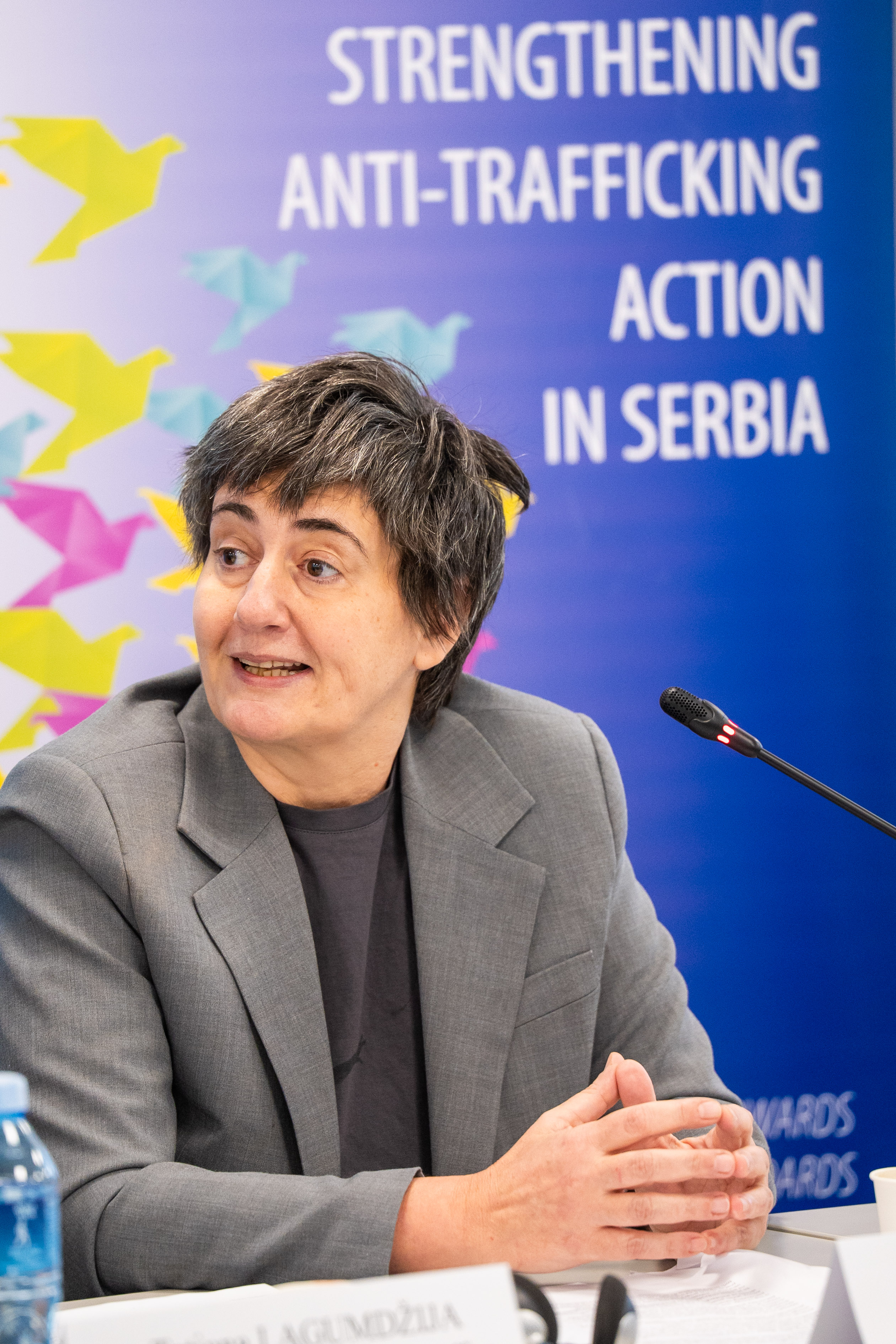
Photo made by: Dragan Mujan (with Marijana Savic, January, 2026)
In partnership with the Council of Europe, NGO Atina organized a roundtable titled “Psychological support for victims of human trafficking: The key to a successful investigation and judicial outcome,” bringing together 90 professionals from Serbia and the region. The event presented the publication “From trauma to testimony: Guidelines for psychological support to victims of human trafficking in criminal investigations and court proceedings,” and highlighted the need to bring this often-sidelined topic back into focus for everyone who may come into contact with victims of human trafficking.
The roundtable was organized within the project “Strengthening the Fight against Human Trafficking in Serbia,” implemented through the joint programme of the European Union and the Council of Europe, “Horizontal Facility for the Western Balkans and Türkiye.” The event was held in a hybrid format, with simultaneous interpretation into English.
Below we share in full the address delivered at the event by Marijana Savić, director of NGO Atina, summarizing our organization’s experience through 23 years of learning alongside survivors:
“I would like to begin by saying that on Sunday, 1 February, we celebrate Atina’s birthday, 23 years of existence. From the very beginning, our Psychological Counselling Service has been, both formally and in essence, the most important part of our support programme. It was created by Dragana Ćuk Milankov, who is here with us today, and, from the start, together with us, built everything that followed: first individual counselling, and then group counselling.
After that, we developed a methodology for peer-to-peer counselling, as well as a dedicated segment focused on the families of trafficking victims, including family mediation. We adapted all of this, considered it from different angles, and developed it with the women and girls who were part of our programme. We adapted our approaches, learned a great deal, and continuously adjusted support so that it truly responds to the needs of victims of human trafficking.
Also, on 16 May 2005, Serbia signed the Council of Europe Convention, and 21 years have passed since then, and throughout that time, we at NGO Atina have been here. We have grown together, alongside the implementation of the Convention. We have institutional memory of what it was like back then, what was developing, how systems were improving, where we are still lagging, and where significant gaps in practice remain. This is especially true when we talk about how psychological support for victims of human trafficking has evolved, and what the relationship of the police, prosecution services, and courts has been, and still is, toward victims of this criminal offence.
Approaches have definitely changed. They have improved and become more sensitive, but we still have much more to do. And that is why we are here today: to discuss how we can change this.
Not only have approaches changed, but the most vulnerable and at-risk groups have changed as well. The types of exploitation have also changed, and what has been predominant in different periods. But one thing has remained the same: without continuous psychological support, we cannot achieve much. The importance of psychological counselling has remained. And it remains true that without long-term individual support, there is no real recovery, and that psychological support is not a single conversation or merely information about rights.
For that reason, this year, so that we could strengthen our entire programme of psychological support, counselling, and psychosocial assistance, we have essentially created a dedicated unit: a special space, adapted to the needs of psychological counselling, in line with the standards set for this type of work.
This is a comprehensive unit designed to help us respond not only to the increased need for psychological counselling and the growing number of women referred to this programme, but also to the broader significance of this space for individuals and society as a whole. And that this is the direction we must take.
Our relationship with survivors has deepened over these years of support; it has grown stronger. Survivors have been increasingly involved in planning, in our strategic responses, and in defining how the system should change, and how we can influence the work of different institutions, policies, and processes.
And as you know, within Atina for many years, there has been an active Advocacy Group of women survivors of trafficking, who, alongside us, follow developments in this field and share their perspectives on these processes.
They recently wrote and published a report on the Draft Law on the Suppression of Human Trafficking and the Protection of Victims, which is expected to be adopted this year. In that report, they dedicated a special section, clearly prioritizing it, to the need for serious and urgent psychological and health protection for victims of human trafficking. They emphasized that for them, this is an existential right.
And that this cannot remain merely declarative in the law, but must be implemented appropriately: it must be continuous, accessible, and it must overcome the practice in which such rights exist only on paper.
They particularly emphasized the principle of urgency, that support must begin at the very moment a person who is a victim, and a person living with trauma, comes into contact with a helper or with the police.
Now, let me return to the publication and to the model of work that we will present to you. During the presentations by Dragana Ćuk Milankov and our colleague, the esteemed Professor Dr Jelena Radosavljević Kirćanski, you will see the key findings and what they tell us about practice.
First, I would like to introduce the participants who shared their valuable experiences with us.
We spoke with 13 women and 2 men. All of them had, at some point, experience with both investigative and court proceedings. In more than 50% of cases, 8 people, the proceedings have been completed, while 7 are still ongoing. The reasons vary: some proceedings were concluded at one point and then returned for further action; some were returned to the beginning; and, in some cases, they continue without clear, concrete outcomes. And this is important to understand: because the length of court proceedings and the “fatigue” of these processes directly affect whether and how victims’ rights are realized at all.
In terms of types of exploitation, in most cases,s it was sexual exploitation. But there were also cases of forced begging, coerced commission of criminal offences, and labour exploitation.
And now we reach a particularly difficult part: some of the victims we interviewed, although identified as victims of human trafficking, and although proceedings were ongoing, were at the same time prosecuted, and even convicted, for criminal offences they committed during their own exploitation.
Most of them were exploited in Serbia. And what is perhaps the most alarming fact of all is that, cumulatively, these victims spent more than 50 years in exploitation, more precisely, 50 years and 8 months. That is more than half a century. Fifteen people. Fifteen lives that endured exploitation and violence.
And here I must return to the most important point: these are not numbers. These are people. These are interrupted dreams. Interrupted education. Interrupted hopes. And immense trauma. And you can imagine how much support is needed for someone to get out of that, not only psychological support, but support in general, so that a person can recover and stand on their feet again.
Today, we will discuss their experience of being rescued, their involvement in investigative and court proceedings, and how they endured them physically and psychologically. And what their recommendations are, what, in their view, the system must change so that what they went through does not happen again.
And now I want to add one important thing, to be fair and precise: we interviewed those who actually reached investigative and court proceedings. Which means there are no interviews with victims, women, girls, or men in cases where proceedings never happened at all. And that is a major “blind spot” of the system.
That is why it is important for us, as professionals and institutions, to ask: why did proceedings not happen in other cases? Was it because there was no adequate psychological support in the first contact? Was the victim not recognized as a victim? Was the case abandoned because ‘there is no evidence’, and what do we do in those situations? What kind of communication with the victim must exist even when proceedings cannot be initiated immediately?
And this brings us to the core: the importance of communication, which Dragana Ćuk Milankov will address in particular. Because that first contact often determines the direction of the investigative and court process. It determines whether trust will be built, whether the victim will remain in the process, whether they will feel heard and understood, and whether they will receive excessive recognition.
And finally, this is also a question of satisfaction and justice: after more than half a century of exploitation in the lives of these women and men, is there satisfaction, and how can we create a system that truly responds to that need: so that the victim feels they are not alone, not to blame, that someone sees them, and treats them as a human being.”
“This material has been produced with the financial assistance of the European Union and the Council of Europe. The contents are the sole responsibility of the author(s). The views expressed herein can in no way be taken to reflect the official opinion of the European Union or the Council of Europe.”




 FACEBOOK
 TWITTER
 YOUTUBE