Hotline: +381 61 63 84 071




Psychological support for victims of human trafficking: A key to successful investigations and judicial outcomes
Psychological support for victims of human trafficking: A key to successful investigations and judicial outcomes
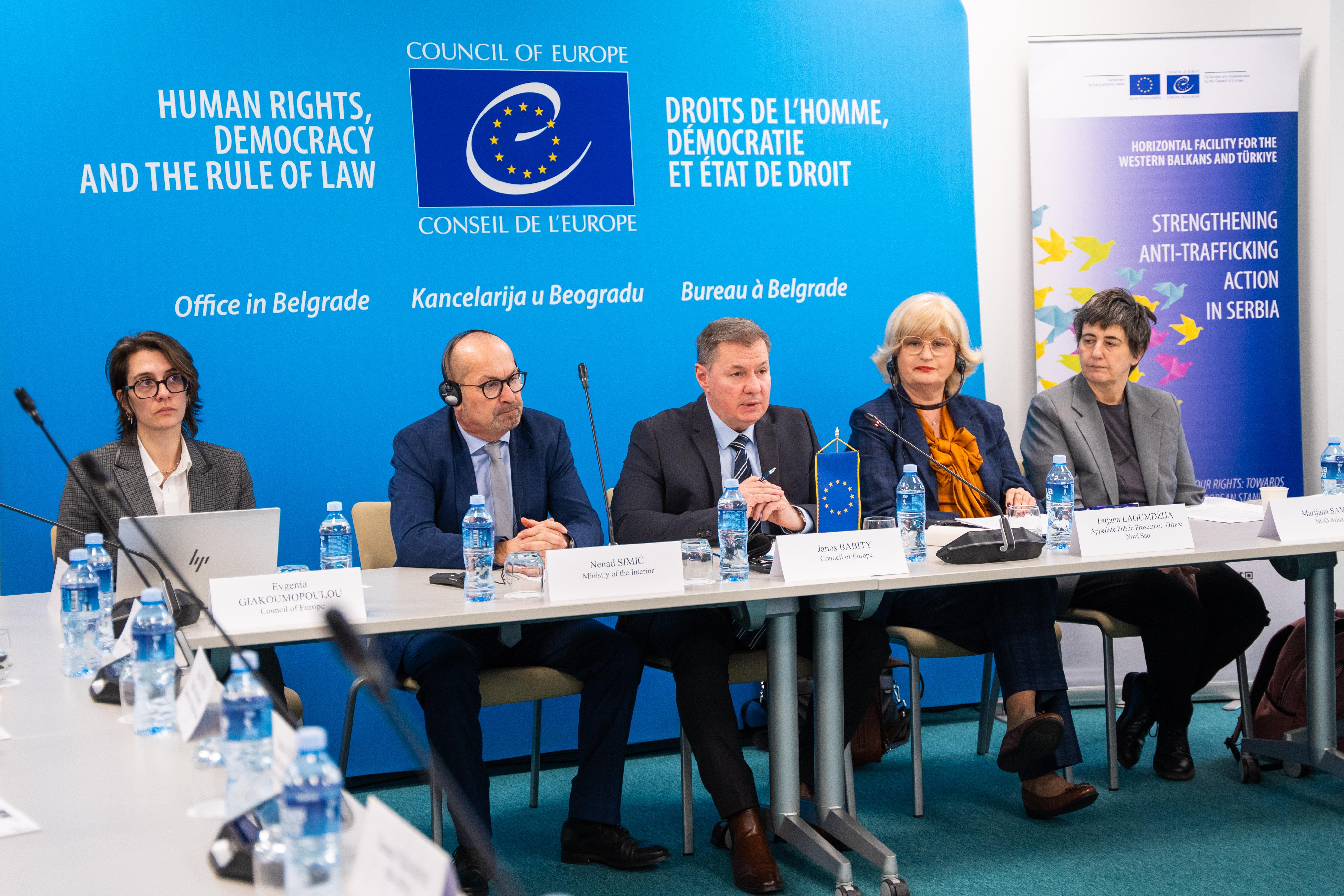
Photos: Dragan Mujan (in the photo: Evgenia Giakoumopoulou (Council of Europe), Nenad Simić (Ministry of Interior), Janoš Babić (Council of Europe), Tatjana Lagumdžija (Appellate Public Prosecutor’s Office Novi Sad), Marijana Savić (NGO Atina) - January 2026)
In partnership with the Council of Europe, NGO Atina organized a roundtable titled “Psychological support for victims of human trafficking: A key to successful investigations and judicial outcomes,” bringing together a total of 90 professionals from Serbia and the region. The event presented the publication “From trauma to testimony: Guidelines for psychological support to victims of human trafficking in investigative and court proceedings,” and highlighted the need to return this marginalized topic to the focus of all those who may come into contact with victims of human trafficking.
The roundtable was organized within the project “Strengthening the Fight against Human Trafficking in Serbia,” implemented through the joint programme of the European Union and the Council of Europe, “Horizontal Facility for the Western Balkans and Türkiye.” The event was held in a hybrid format, with simultaneous interpretation into English.
In addition to presenting the Guidelines developed by the NGO Atina, the roundtable aimed to: assess progress and challenges over the past year from the perspective of institutions and civil society organizations working to combat human trafficking; remind participants of European standards and GRETA recommendations regarding psychological support to victims of trafficking, with particular emphasis on their importance for access to justice; and, through discussion, define recommendations for improving the protection system, especially in terms of access to adequate psychological support, inclusion of experts, and strengthening intersectoral cooperation.
“There is no true recovery without achieving justice”
In the opening remarks, a message from a woman with lived experience of trafficking was highlighted: “There is no true recovery without achieving justice,” stressing that justice is not an abstract concept, but a process through which the victim has the opportunity to regain a sense of control, dignity, and social recognition of the violence survived.
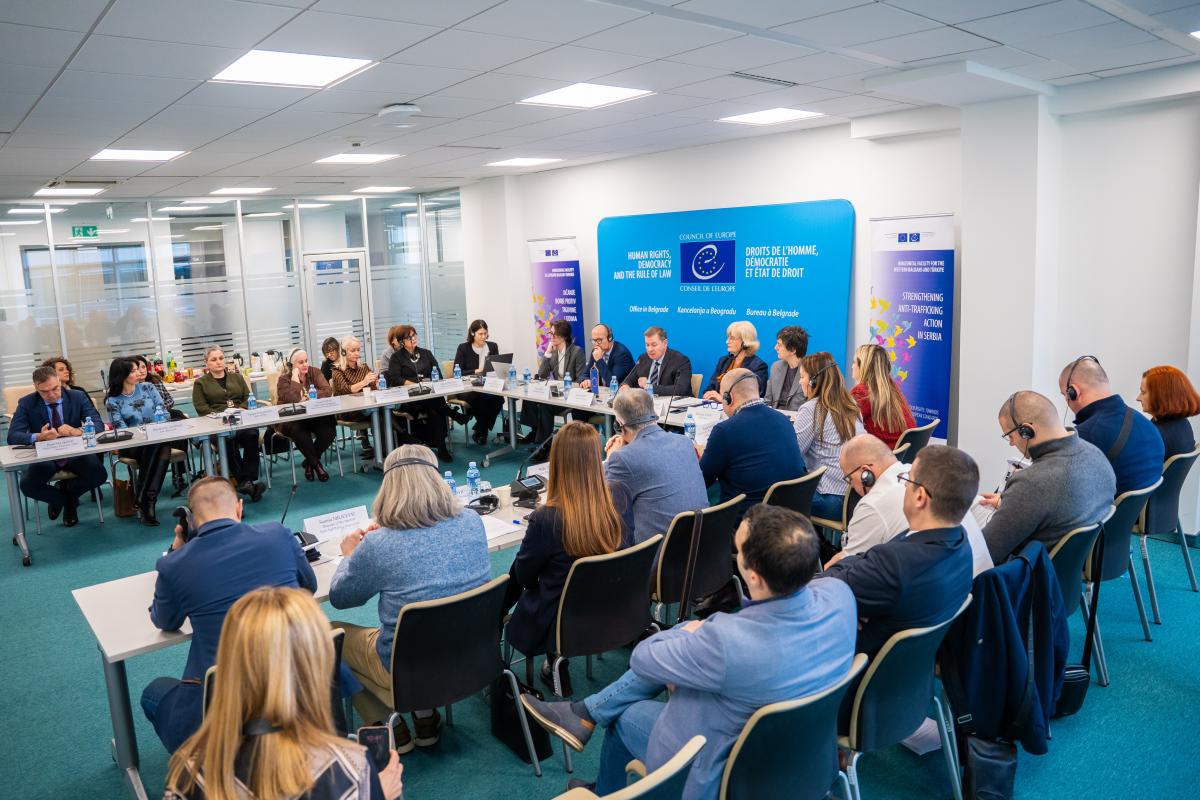
The roundtable was attended by representatives of institutions and services, including the Ministry of Interior and the Office for Coordination of Activities in the Fight against Human Trafficking, SBPOK, as well as police departments (Belgrade, Novi Sad, Pančevo, Kragujevac, Šabac); higher public prosecutor’s offices (Belgrade, Pančevo, Kragujevac, Šabac); the Centre for Protection of Victims of Human Trafficking, NGO ASTRA, the Belgrade City Centre for Social Work, witness/victim support services (Belgrade, Novi Sad, Kragujevac), the law office Golubović Simić Marinković (Dina Kocić Santrač, an attorney who has represented trafficking victims on behalf of the NGO Atina for more than a decade), as well as representatives of embassies, UN agencies, and colleagues from the region, Slovenia, Bosnia and Herzegovina, Montenegro, and Kosovo*.
In the opening session, remarks were delivered by Janoš Babity, Head of the Council of Europe Office in Belgrade; Tatjana Lagumdžija, Chief Public Prosecutor at the Appellate Public Prosecutor’s Office in Novi Sad; and Nenad Simić, National Anti-Trafficking Coordinator and Head of the Office for Coordination of Activities in the Fight against Human Trafficking within the Ministry of Interior. The Head of the Council of Europe Office emphasized that a society is only as strong as the way it cares for its most vulnerable, and underlined the importance of perseverance, continually reminding the public of the threats posed by human trafficking and remaining relentless in that effort. Chief Public Prosecutor Lagumdžija emphasized that impartiality and fairness are enduring commitments that every prosecutor must uphold, citing the handbook “Communication with Witnesses and Injured Parties,” which has been in use for many years. Nenad Simić discussed Serbia’s strategic framework in this field and noted that much remains to be improved at the operational level. The remarks underscored the importance of intersectoral cooperation, strengthening institutional capacities, and reinforcing a victim-rights-based approach, with a focus on access to support that enables safe participation in proceedings.
The thematic framework was introduced by Petya Nestorova, Executive Secretary of the Council of Europe Convention on Action against Trafficking in Human Beings, and Marijana Savić, director of the NGO Atina. Petya Nestorova stressed that psychological support to victims is an essential precondition for safe participation in proceedings and access to justice, and that a trauma-informed approach must be a systemic standard in implementing the Council of Europe Convention and GRETA recommendations. In her remarks, Marijana Savić noted that the NGO Atina marks 23 years of work this year, and that psychological counselling has from the very beginning been “formally and substantively the most important part” of support to victims of trafficking, developed over the years together with women and girls in the programme (from individual and group counselling, to peer-to-peer support and work with families). She emphasized that without continuous, long-term psychological support, there is no real recovery, and that “these are not numbers, these are people,” with interrupted dreams, education, and immense trauma. She stressed how crucial it is for the system to recognize the “blind spot” of cases that never reach proceedings, and for first contact, communication, and trust to be trauma-informed, because these elements often determine whether a victim will remain in the process and whether justice and redress will be achieved at all.
The discussion highlighted that psychological support is not an add-on to the system but a condition for achieving access to justice. In particular, the need was emphasized for trauma-informed practice to be standardized through procedures and practice, rather than left to the individual capacities and “goodwill” of particular professionals.
The Guidelines were presented by Dragana Ćuk Milankov, clinical psychologist and Head of the Counselling Unit for the Psychological Recovery of Victims of Human Trafficking at the NGO Atina, and Prof. Dr. Jelena Radosavljev Kirćanski, Institute of Mental Health, Clinic for Children and Youth. The presentation covered key principles of psychological support in investigative and court proceedings: understanding trauma, preventing secondary victimization, enabling safe testimony, ensuring continuity of support, and cooperation between psychologists/psychotherapists and institutions within frameworks that protect confidentiality and the victim’s autonomy. It was particularly emphasized that judicial proceedings can have therapeutic potential, but only if conducted with understanding, care, and respect toward those involved. The publication starts from a key message: the quality of judicial proceedings and the psychological well-being of victims are not opposing goals, but inseparably linked; without a trauma-informed approach, there can be no safe testimony, reliable statements, or a fair outcome. The Guidelines were developed based on Atina’s 23 years of practice and experience working with victims, using an interdisciplinary approach that connects psychological support, legal protection, and long-term recovery and reintegration support. A special value of the publication is its empirical section based on interviews with 15 survivors of human trafficking, whose experiences from investigation and trial provide clear, practical guidance on how proceedings can be both effective and less re-traumatizing. The publication is intended for everyone who comes into contact with victims of trafficking, from the judiciary, police, social and health services, and civil society organizations, with a clear goal: reducing secondary and repeated victimization and strengthening practices that protect the victim, not merely the system’s “form.”
In the final part, a discussion was held to develop recommendations to improve the protection system and access to justice. Participants from institutions and civil society pointed to inconsistent practice, risks of secondary victimization, and interruptions in support, especially in situations where psychological help is not systemically available or is left to individual resources and local capacities. The following common points were identified:
1. Ensure the availability of psychological support as a standard, not an exception
Psychological support must be systemically available to victims at all stages of proceedings, from first contact to the completion of recovery, through clearly defined referral mechanisms.
2. Standardize the trauma-informed approach
It was recommended that trauma-informed practice be consistently embedded in protocols and training (police, prosecution, social work centres, support services) to reduce secondary victimization and improve the reliability of statements and the quality of proceedings.
3. Define roles and strengthen intersectoral cooperation
The need was emphasized for clear roles and coordination between institutions and specialized civil society organizations, while respecting confidentiality and professional standards of psychological support.
4. Ensure timely support to witnesses/injured parties and protective measures in proceedings
The importance was highlighted of providing victims with timely information, support, and protective measures, so that participation in proceedings takes place without additional risks and re-traumatization.
5. Establish continuity of support during and after proceedings
Support must not end when formal procedural actions are completed; long-term stabilization and reintegration are essential for genuine recovery.
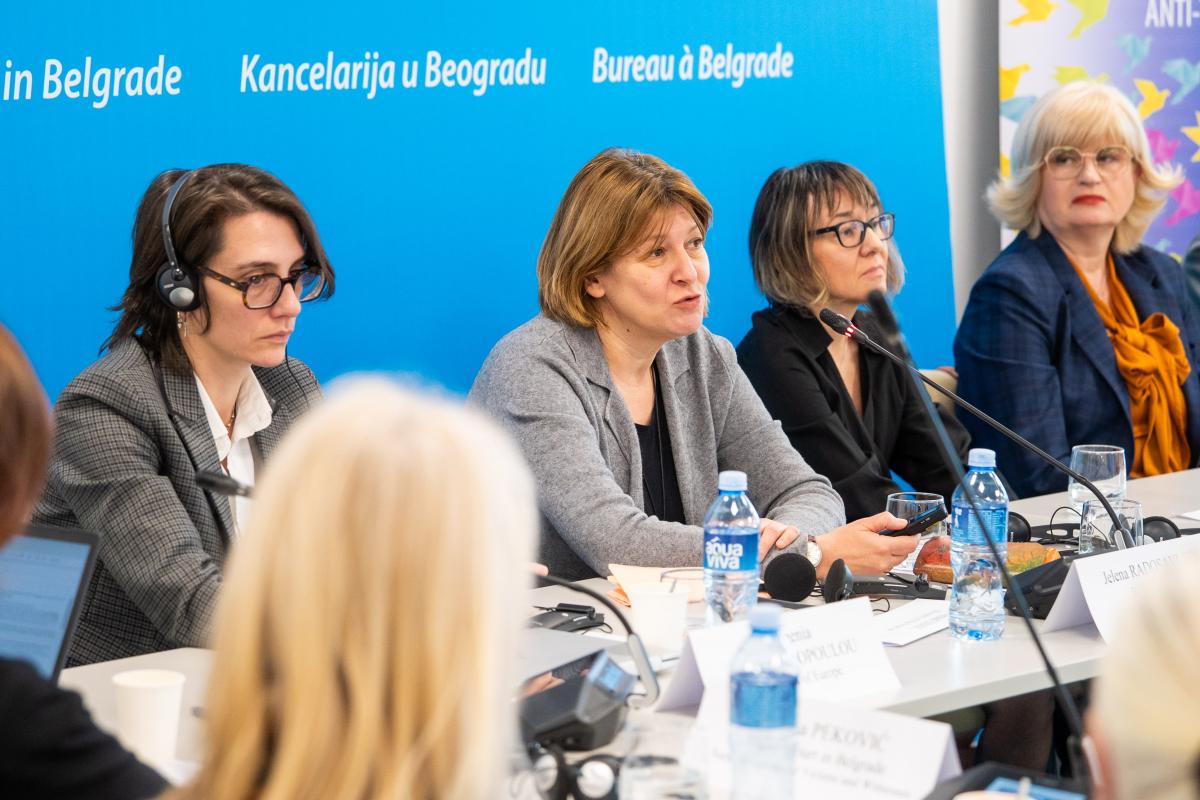
The roundtable confirmed the widely recognized need to view psychological support for victims of human trafficking as a key element of access to justice and quality proceedings, rather than an additional, sporadic service. The Guidelines presented by the Atina Association offer a concrete tool for improving practice and a call to ensure, through standards, training, and intersectoral cooperation, a system that protects the victim while strengthening the effectiveness of investigations and judicial outcomes.
“This material has been produced with the financial assistance of the European Union and the Council of Europe. The contents are the sole responsibility of the author(s). The views expressed herein can in no way be taken to reflect the official opinion of the European Union or the Council of Europe.”




 FACEBOOK
 TWITTER
 YOUTUBE