Hotline: +381 61 63 84 071





In the Shadows. Marked. Targeted. Judged.

In the Shadows. Marked. Targeted. Judged.
Digital gender-based violence as an invisible, yet pervasive experience of women and girls
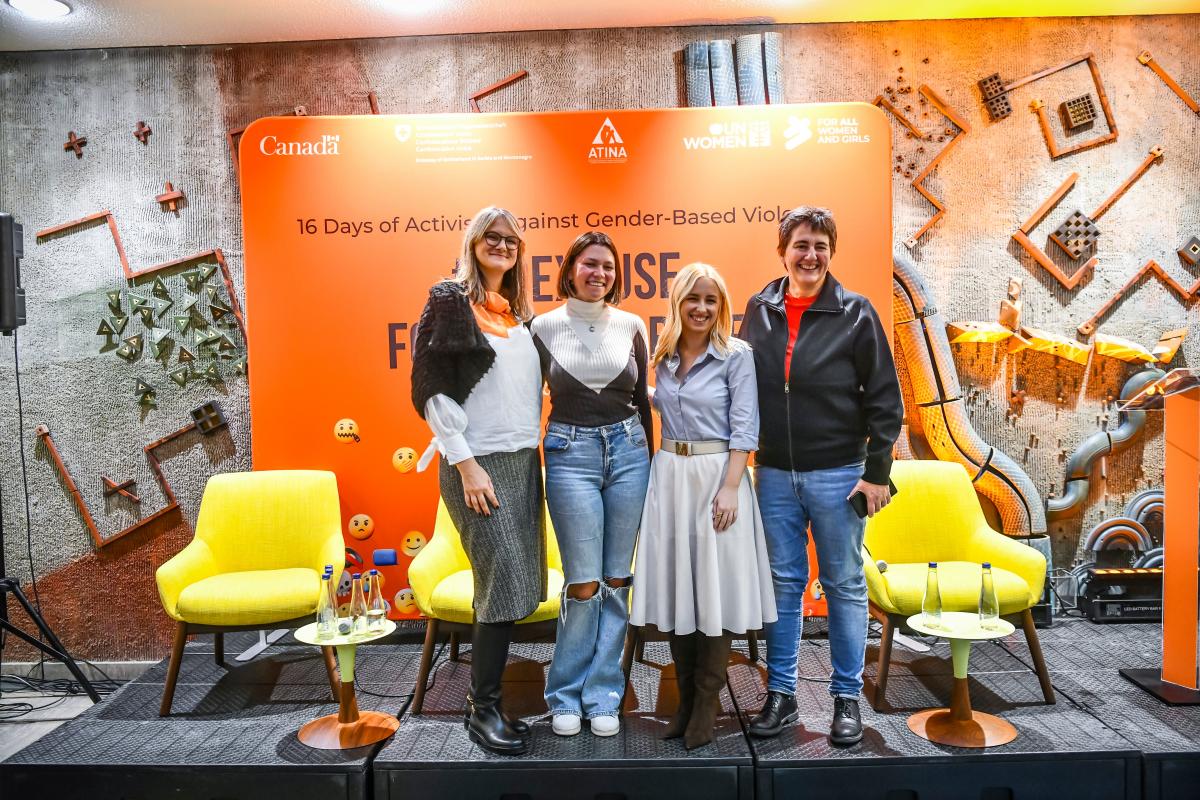
As part of the “16 Days of Activism against Gender-Based Violence” campaign, on 4 December 2025, in Belgrade, at the premises of the Embassy of Canada in Serbia, North Macedonia, and Montenegro, a panel and performative experience dedicated to digital gender-based violence was held under the title “Violence in the silence of the digital space.”
Photos: Goran Srdanov
The event brought together experts and activists working from different angles on digital rights, youth, and direct support to women who have survived violence, to shed light on what too often remains invisible: how digital violence emerges, how it becomes “normalized,” and why the system still fails to respond adequately.
Digital violence does not begin “on the internet” - it begins in inequality.
The panel discussion was moderated by Olja Janković Leković (UN Women), who emphasized in her opening remarks that digital violence is not a separate phenomenon. Still, a continuation of gender-based violence by other means, taking place in a space that is often beyond the reach of institutional protection, yet deeply affects the lives of women and girls. The discussion focused on where digital violence truly begins and how it manifests.
Mila Bajić from the SHARE Foundation spoke about the specific features of digital violence against women, stressing that it often takes forms that are both mass-scale and highly personalized, from targeted hate campaigns to the abuse of intimate content and continuous online surveillance. She particularly highlighted the role of the media and platforms in normalizing violent narratives.
Milica Borjanić from KOMS cited alarming findings from alternative reports indicating that young women and girls face multiple risks in the digital space due to inadequate protection mechanisms. Digital violence against young people is often not recognized as violence, but rather as a “normal part of growing up,” which further deepens feelings of guilt and helplessness.
From the perspective of working with women who have survived violence, Marijana Savić from NGO Atina emphasized that digital violence often develops gradually, through control, threats, blackmail, and the misuse of technology. At the same time, its consequences become visible only when safety and psychological risks are already serious.
A system that doesn’t see - or doesn’t want to see
The second round of the panel focused on the institutional response to digital violence, examining what the system is doing today and where accountability is lacking.
Marijana Savić noted that women who decide to seek help often encounter misunderstanding, fragmented jurisdictions, and a lack of clear procedures for handling cases of digital violence. Although formal reporting options exist, in practice, they are difficult to access, and women are often discouraged from the outset in their first interactions with institutions.
Mila Bajić reflected on the normative framework, recalling years of advocacy to criminalize the abuse of intimate content and pointing to existing legal gaps. While some progress has been made, platform accountability remains insufficiently defined, and victim protection is uneven.
From the perspective of young people, Milica Borjanić highlighted deep distrust in institutions and a sense that the system does not understand the digital context in which young people live. Young women often do not know where to turn, nor do they believe their experience will be taken seriously.
Field experience: consequences that persist
The third part of the discussion focused on real cases and trends observed in the field.
Milica Borjanić discussed youth initiatives, such as activism within the “Osnažene” program, that demonstrate young people can raise issues like “revenge porn” and online safety, but they need systemic support.
Mila Bajić presented findings from the SHARE Foundation’s monitoring databases, highlighting a growing number of reported digital rights violations, differences across platforms, and the emergence of new tactics of violence that quickly adapt to technological change.
Marijana Savić particularly emphasized the psychological and safety risks women face, including prolonged fear, a loss of control, and withdrawal from public and digital life. She stressed that digital violence is never “only online,” but has very real consequences for women’s mental health, safety, and social relationships.
What’s next: from recognition to accountability
In the closing part of the panel, the speakers highlighted key recommendations to improve prevention and protection: strengthening digital literacy and platform accountability; empowering young people through campaigns and networks that speak their language; building institutional capacity; and integrating digital violence into existing mechanisms to protect women from violence.
The panel concluded by stating that there is no justification for digital violence and called for shared responsibility across institutions, platforms, media, and society as a whole. The event once again confirmed that digital gender-based violence must be recognized as a serious form of violence, requiring a systemic, gender-sensitive, and trauma-informed response.
Wider programme and research presentation
On the same day, as part of the “16 Days of Activism against Gender-Based Violence” campaign, a broader programme was held, opened with introductory remarks from representatives of the international community and institutions. The gathering was addressed by H.E. Michelle Cameron, Ambassador of Canada to Serbia, North Macedonia and Montenegro; Tatjana Macura, Minister without Portfolio in charge of gender equality, prevention of violence against women, and women’s economic and political empowerment; H.E. Anne Lugon-Moulin, Ambassador of Switzerland to Serbia; Plamena Halacheva, Deputy Head of the Delegation of the European Union to the Republic of Serbia; and Jelena Sekulić Nedeljković from UN Women Serbia. In their remarks, they emphasized the importance of recognizing digital gender-based violence as a serious social problem and the need for stronger institutional and cross-sector cooperation to address it.
In the continuation of the programme, Jelena Hrnjak, Programme Manager at NGO Atina, presented findings from the research “Ne lajkuj nasilje - Research on Digital Violence against Women and Girls in Serbia,” published by NGO Atina with the support of UN Women. The research points to the prevalence of various forms of digital violence, their links to offline violence, and the serious consequences such experiences leave on women’s safety, mental health, and social participation. The presentation further reinforced the panel’s messages, confirming that digital violence is not an isolated incident but a structural problem requiring systemic, gender-sensitive, and long-term responses.
Photos from the event are available at the link: In the Shadows. Marked. Targeted. Judged.



 FACEBOOK
 TWITTER
 YOUTUBE